
A New Hemp Ban, An Old Prohibition
Posted November 15, 2025 in Cannabis Politics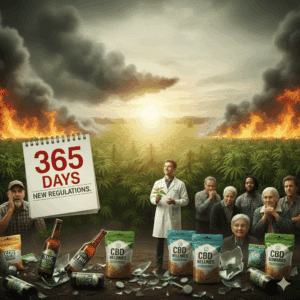 Congress Uproots A $28 Billion Industry
For the past seven years, hemp-derived THC products have become a fixture of American retail. Beverages, gummies, and edibles sit openly on the shelves of gas stations, convenience stores, and even major retailers such as Target, Circle K, and Total Wine. This mainstream presence created a booming, federally legal industry that flew under the radar of many.
That era of quiet growth just came to an abrupt end. In a calculated political maneuver, Congress placed a provision deep inside the must-pass spending bill that ended the longest federal government shutdown in American history. The legislative fiat effectively outlaws the vast majority of these products, putting a $28 billion American industry on a 365-day countdown to extinction.
This article distills five surprising facts behind this sudden and dramatic policy shift that threatens to dismantle an industry from the top down.
The Architect of the Industry Is Now Its Executioner
The ultimate irony of this new ban is its author: Senator Mitch McConnell (R-Ky.). The very same legislator who championed the 2018 Farm Bill, the landmark legislation that created the legal loophole for the hemp industry to flourish, is the one who authored the provision to kill it. Citing concerns that the products are “poisoning Kentucky’s kids,” McConnell pointed to data showing calls to the Kentucky Poison Control Center have “more than doubled over the last five years, with 40% of those calls in regards to children under 12.”
>The whiplash felt by industry leaders is palpable, as captured by Thomas Winstanley, executive vice president of Edibles.com: “Mitch McConnell, the man who gave us the seeds to grow hemp, now wants to burn the crop and salt the ground.”
An Unlikely Alliance of Rivals
The push to close the hemp loophole was not driven by a single ideological group. Instead, it was the result of a coordinated lobbying effort by an unlikely alliance of direct competitors and historical opponents who united to eliminate a common economic threat. The key supporters of the ban included:
• The regulated state-legal marijuana industry: Companies like Curaleaf, which operate within the strict, state-licensed cannabis system, view the largely unregulated hemp market as “an unwelcome competitor playing by different rules” and sought to “reduce competition from unregulated intoxicating hemp products.”
• Major alcohol industry lobbies: Seeing the billion-dollar THC beverage market as a direct threat, powerful alcohol groups lobbied hard, arguing that THC beverages “aren’t taxed or regulated in the same way as alcohol,” creating an “uneven regulatory playing field.”
• Staunch anti-legalization advocates: Public health groups and anti-drug advocates, who oppose cannabis in all its forms, joined the effort to crack down on what they see as a dangerous and unregulated market.
• A bipartisan group of state attorneys general: Citing public health concerns and the difficulty of enforcing patchwork state laws, 39 state attorneys general urged Congress to take federal action.
This unusual alliance demonstrates a political reality: when market share is at stake, ideological enemies and fierce business rivals can quickly find common ground.
This Wasn’t a Fringe Market—It Was a Mainstream Juggernaut
The hemp-derived THC sector was far from a niche market; it had become a massive, mainstream economic force. While its products were often sold in unassuming locations, the industry’s scale was anything but small, with products sold alongside beer and wine in states ranging from Minnesota to Tennessee. The numbers speak for themselves:
• The industry was valued at over $28 billion.
• It supported more than 300,000 jobs across the country.
• THC-infused beverages alone generated approximately $1 billion in annual sales.
This wasn’t just a collection of small smoke shops. Mainstream giants like Edible Arrangements had launched hemp THC product lines. Legendary entertainers Cheech & Chong built a $100 million business in the space, cementing the industry’s arrival in the heart of American commerce.
The Ban Hits More Than Just “Intoxicating” Products
Perhaps the most counter-intuitive impact of the law is that it will decimate the market for non-intoxicating wellness products, particularly CBD. While the bill was publicly aimed at “intoxicating” products, its mechanism is a blunt instrument that wipes out nearly everything.
The new law imposes a strict limit of 0.4 milligrams of THC per container.
This is a microscopic amount, and according to legal analysis from Akerman LLP, the new cap is so restrictive that “More than 90% of currently available non-intoxicating CBD products exceed the new 0.4 mg per-container cap.” The U.S. Hemp Roundtable estimates the ban will effectively wipe out 90-95% of the entire existing hemp market. This includes full-spectrum CBD oils relied upon by veterans, seniors, and other vulnerable populations for wellness, not intoxication. Jim Higdon, cofounder of Cornbread Hemp, highlighted the real-world impact on his customer base: “Our universe is catering to women over 65 who cannot sleep. They love us.”
The Industry Isn’t Dead Yet—A 365-Day Countdown Has Begun
While the bill has been signed into law, the ban is not immediate. Congress included a 365-day implementation window before enforcement begins. This grace period has created a schism within the industry, with leaders interpreting it in two very different ways.
Some, like Thomas Winstanley, are taking an optimistic view, framing the deadline as an opportunity. He sees it as “one year to regulate,” a window to lobby Congress for a more sensible federal framework that preserves the industry while addressing safety concerns.
Others are taking a more pragmatic, if fatalistic, approach. Angus Rittenburg, CEO of the beverage company Wynk, said his company and distributors are launching a “full-court press” to generate as much revenue as possible before the ban takes effect. This countdown clock has created massive uncertainty for farmers planning next year’s crops and for the thousands of businesses that now face what Jim Higdon has called an “extinction level event.”
Conclusion: A Battle for the Future
A massive, mainstream American industry now faces an existential threat from its original creator. The shockwaves are just beginning to be felt by hundreds of thousands of employees, farmers, and consumers. With the 365-day clock now ticking, the battle for the future of hemp has just begun. Will the coming year lead to sensible regulation, or will a $28 billion American industry simply go up in smoke?